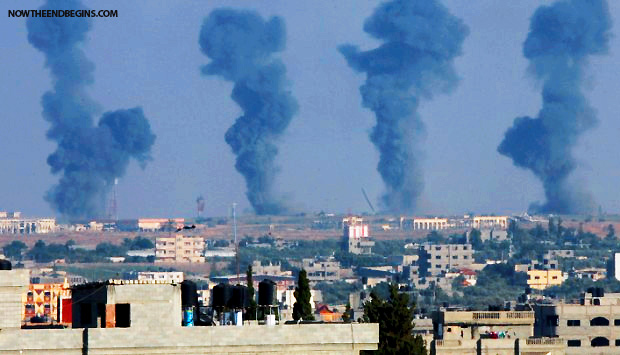
A new piece has emerged from Sam Harris, which represents his first piece of foreign policy commentary in a while now. It seems he's becoming rusty, because this one contains literally no references whatsoever, and exhibits such a horrendously biased interpretation of the current conflict that its prejudices are worth examining in some detail.
What strikes me as a particularly
odious part of Harris’ piece is that murderous intent expressed by
Hamas is given front and centre of the piece’s focus, but equally offensive, racist, theocratic expressions by Zionists are ignored. I’m going to hazard a guess that Harris hasn’t
actually read the accounts of Zionists describing the brutal
Operation Cast Lead, in which over 1,400 Palestinians were killed as
“mowing the lawn”, because if he had it would call into doubt his
claim that Israel bombs civilians in sorrow rather than in anger.
“If we kill their families, that will frighten them” - not, as you would perhaps first guess, the brutal injunction of a
jihadist death-cult leader, but a recent statement from reserve IDF
general Oren Schachor. One doesn’t have to search far to find
examples of Israeli justifications for Operation Protective Edge
being couched in violent, retributive terms, such as the far-right
Israelis revelling in there being “no school tomorrow” in Gaza after the IDF obliterated a UN-run school, killing 19 people and
injuring nearly 100. Again, I'm sure Harris would condemn this, but
make an aside that Israel is nonetheless pure in its intentions
towards the Palestinians, because of reasons.
Even in apologising for its own
citizens' crimes, the Israeli state seeks to demonise the oppressed
population of the Palestinian Territories in any way it can. See, for
instance, Prime Minister Bejnamin Netanyahu’s response to the
brutal murder by a group of ultra-Zionists of Palestinian teenager
Mohammad Abu Khdeir, beaten, then forced to drink
gasoline before being set on fire and burning to death. The apology?
That “…there is no place for such murderers in our society. In
that we stand apart from our neighbours – In their society
murderers are seen as heroes and have squares named after them” –
one would be forgiven for forgetting, for a moment, that what was
being decried were the actions of Israeli citizens. Even these can be
attributed to being more closely aligned with the supposedly
murderous Palestinian character, in the eyes of the Israeli state.
These injunctions to
racism and demonisation of the populations of the Palestinian
territories surely bely Harris’ claim that all Israel wants is to
live peacefully with its neighbors and expand its technology sector.
In any case, why the Israeli population would want to live peacefully
besides people it considers to be members of a death cult is never
explained, nor does Harris explain why the Israelis themselves should
desire this. He points to the Hamas charter, a decades-old document
generally ignored or denounced by the Hamas leadership, of evidence
of the Palestinian’s murderous intent towards Jews. So if the
charter is such a big deal, why bother making injunctions towards
peaceful co-existence? There couldn’t be peaceful co-existence with
the Nazis, after all, how can there be peaceful co-existence with a
group of people who are, according to Harris, murderous anti-semites?
It’s this kind of racist portrayal of the Palestinians as being a
revenge cult that impedes progress towards a peace settlement and
it’s exactly the kind of racism – yes, racism – that pervades
Harris’ article.
The obvious retort to
Harris’ invocation of the Hamas Charter is that the Hamas charter
is in no way representative of the goals of the Palestinian
population or even Hamas as an organisation. All it takes is one lazy
Wikipedia search to find a quote from Khaled Meshaal, the leader of
Hamas, stating that the Charter is “a piece of history and longer
relevant.” Of course, none of that matters if your intent is to
demonise the Palestinians and blame elements of their leadership for
the massacring of civilian children. You can just refer to the
Charter willy-nilly as if it weren’t written decades ago and
rejected in modern times. This is not understanding a situation –
it's simplistic grandstanding.
Harris says that all we
need to do in order to understand the “moral difference” between
Israel and Hamas is to “ask what each side would do if they had the
power to do it”, but this is a silly thought experiment that is too
abstract and hypothetical to be of any practical value in a conflict
which is currently occurring. It’s a crude form of denialism which
demands that rather than analyse the actions of the IDF as they are
right now, we should instead envisage an entirely fictional conflict,
in which dynamics, economics, politics, history and political support
are completely reversed and judge the actions of Hamas in that,
instead. Why we need to perform these mental acrobatics and imagine
conflicts by which we should judge Hamas’ non-existent actions is
beyond me, since we have a conflict currently unfolding before our
very eyes in which over 1,300 civilians are dead, thousands more
injured and nearly half a million displaced. “War crimes are war
crimes”, Harris states. Indeed, they are – so why is the piece
entitled “Why I Don’t Criticise Israel”? Surely war criminals
are not beyond a bit of criticism?
Harris’ bizarre
thought experiment is representative of a particular strain of
Harris’ thought which posits religions as mere ideologies; as
static things to which people arrive independent of outside influence
and then become inspired to action. In Hegelian terms, this is called
'idealism', and it was kindly refuted by a couple of German philosophers over a century ago. To demand that religious extremists give up their
religion, as Harris does (a goal I share, incidentally) is to demand
the end to a condition which requires religious extremism, not a
simplistic condemnation of the ideas themselves.
In Harris' world, all
that matters is the ideology, therefore, if it were the Palestinians
who had their own technologically advanced state which had illegally
occupied two densely populated Israeli areas since 1967 and placed
them under brutal occupation, the dynamics of the conflict and
rhetoric of both sides would nonetheless remain the same. Thus we can
use the Hamas charter as a useful indicator of how Hamas would
actually behave if this thought experiment were a reality. As with
Harris' approach to theology, all that matters is fundamental
principles – nuance and development of the jihadist cause from its
roots is irrelevant.
Incidentally, the
extreme of Hamas, generally speaking, advocates for an outcome in
which all of Israel becomes the state of Palestine. That's
undoubtedly an unworkable position, but it's a far cry from Harris'
claims that Hamas explicitly desires genocide. Genocide has a very
specific legal definition, and throwing it around is ill-advised,
because it cheapens the meaning of the term as one reserved for the
highest international crime imaginable. The more moderate wing of
Hamas, meanwhile, advocates for a two-state solution. Now, Harris
does say in his piece that it's wrong to equate Hamas with the whole
of the Palestinians, but I'll submit to the reader that really this
is just another typical example of Harris trying to have his cake and
eat it – trying to deflect criticism by claiming what he said is
not what he actually meant. Later on in the article he says that the
“Palestinians are trying to kill everyone. Killing women and
children is part of the plan” and describes Israel as being
“surrounded by people who have genocidal intentions towards them”.
I'll leave the reader to decide what Harris' general opinion of the
Palestinian population of over 4 million people is.
A
far more odious claim in Harris' piece is to lay the blame for
Israeli war crimes at the door of the Palestinians themselves.
Israeli war crimes can be explained and understood because the
Israelis have been “brutalized by this process – that is, made
brutal by it. But it is largely due to the character of their
enemies.” One is reminded of the old joke about the British soldier
stabbing to death the Irishman, sobbing harder with each thrust of
the bayonet. The Irishman, in his dying breath, incredulously asks
the British soldier why he's crying. The soldier wipes a tear away -
“we will never forgive you”, he says, “for what you've made us
do to you”. If that seems too parodic, perhaps consider former
Israeli PM Golda Meir's statement that “we cannot forgive [the
Arabs] for forcing us to kill their children.” One was a joke,
another was grandstanding from a colonialist – what's Harris'
excuse?
Of course, his excuse
is that he's simply making a point about the reality of fighting
multiple wars. Only Israel is not fighting a war. It is conductingmilitary action in territories which it has illegally occuped fornearly 50 years.
Furthermore, the injunction that Israel is engaging in self-defense
would require acknowledgment that Palestine is a state, something
explicitly denied by Israel and would also require a lack of
effective control over the occupied areas, something which Israel
does exercise. Since Israel under the laws of occupation has a greater
duty to protect civilian life than it would in a genuine wartime
situation, it should not garner praise for what Harris claims is its
commendable restraint in this and other military action against the
occupied territories – it should receive the utmost condemnation
for not exercising enough. The Palestinian Territories are not a
belligerent in an external armed conflict, and it serves us well to
reiterate that Israel has illegally occupied the West Bank and Gaza
since 1967, again something conveniently left out of Harris' piece.
In any case, it's true
to the point of truism that war has a detrimental effect on the moral
character of its participants. Picture Old Major from Fawlty Towers,
whose only good word about the Germans is that their women are “good
card players” or John McCain's occasional use of the word “gooks”
to refer to the Vietnamese. It's entirely correct that Israeli
brutality can be explained by the nature of the conflict. That said,
I don't see why only Israel gets this sort of empathy, yet the people
living in the Palestinian Territories, the majority of which are far
more likely to have a family member who was killed or wounded than
the average Israeli citizen is, are condemned for following an
extreme ideology. Can we not expect some consistency in what was an
otherwise fairly salient point?
Ultimately, Harris' piece
demonstrates that he's once again on the wrong side of history with
regards to the inherent rightness of the west and her allies. The day
will hopefully one day come when the Israeli occupation of Gaza and the West
Bank is behind us, the Palestinians have their own separate state,
and we can see the occupation in the same way we see view the
oppression of blacks in South Africa under apartheid. In the
meantime, we will have to put up with a lot more ill-informed
apologia like that present in Harris' piece. Hopefully the rest of us
will have some good sense to exercise some empathy and that
much-sought after but rarely exercised critical thought.

No comments:
Post a Comment