
Autosarcophagy, otherwise known as self-cannibalism, is a
phenomenon observed particularly amongst cold-blooded reptiles exposed to high
temperatures. If, say, an anaconda overheats, it can become disoriented, and as
its metabolism enters into overdrive, this confusion is accompanied by ravenous
hunger. This leads to the phenomenon portrayed in the ouroborus symbol, in which the animal turns towards itself as its
primary food source. Of course both ouroborus
and the snake fail to understand the fundamentals of the event; what is
happening is neither eternal rebirth nor a much-needed food source, but agonising
suicide.
The Labour Party lost in 2015, badly. And like the snake
slow-cooking underneath the glow of the hot sun, it is looking for sustenance
and turning inward. If you think that I’m going to employ this metaphor in an
attempt towards the conclusion that Corbyn is Bad because he is forcing the
Labour Party to devour itself through a throwback to the out-of-touch socialism
of the 1980s you’ll have to read on. In this topsy-turvy scenario of modern-day
Labour, it’s the supposedly level-headed, rational grown-ups of the party who
have taken a couple of opinion polls to spell eternal doom for the party and
are now biting the tail-end (that’s Corbyn et
al, if you haven’t followed me) in order to derive sustenance for the party’s
electoral future.
You would think that the existential undoing of opinion
polling during the 2015 election might have given them pause for thought, not
least because this is the first Labour election in which the
one-member-one-vote system is employed, and so therefore any sort of opinion
polling comes with the obvious caveat that we
just don’t know who is voting yet. One might, therefore, feel that the
party would be best-placed to urge caution on behalf of its right-wing, lest it
cause more harm than good in driving up a civil war in the Labour Party between
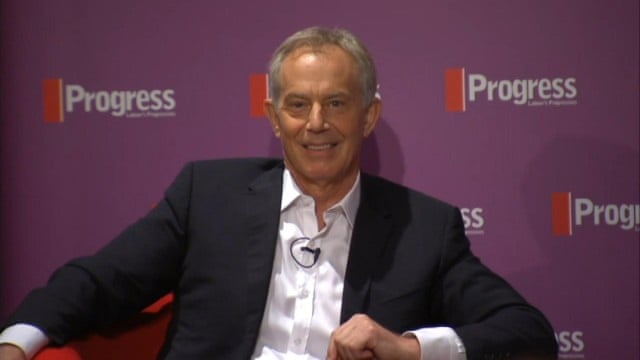
Corbynites and, well, everybody else. Before our much-disgraced ex-Prime
Minister gave a speech in which he recommended the extermination of not just those on the left of the party, but their extended family, a la North Korea's "three generations of punishment" policy , there was no real
fight. There was just a previous long-shot doing better than expected.
Employing the big guns before the voting has even begun has
laid the grounds for an inter-factional dispute in the Labour Party for the
entirety of this Parliament. Since the Blairites have framed this as a fight as
opposed to a contest, whichever candidate wins will inevitably find themselves
managing a war in which the first shots were fired by the side supposedly
interested more in pragmatic electoralism than ideology. Of course, every
leader of an opposition party has to do this to some extent, but the level of
contempt shown by the Blairites for what is quite evidently a motivated section
of Labour’s base will already have created an enormous amount of bad blood
between the left and the right of the party which will prove difficult to clear
up. For all his talk of being focused on “the world as it is and not as we want
it to be”, Blair fails to apply that same logic towards his own party and
recognise that if Corbyn is even half as competitive as some polling suggests,
then the left should be listened to and brought into the discussion. At the
moment, the party seems to treat its grassroots as an annoyance which distracts
from allowing the grown-ups to talk. As others have pointed out, many of Corbyn’s
policies are highly popular with the general public – why not consider that for a second?
The thinking within the Labour Party is understandable. They
lost Scotland, badly, and whilst a guy like Corbyn is probably left-wing enough
for Scotland, he is not Scottish enough for Scotland. The best Labour could
hope to do there under a Corbyn leadership would be claw back a few of the more
marginal seats gained by the SNP, but Labour knows it cannot rely on Scotland
any more like it has done in the past. Its focus is turned more towards the “heartland”
– towards seats it expected to win, in 2015, but failed to.
The solution, so the thinking goes, is to try and outfox the
Tories in some of these marginal seats in the south of England. Conventional
wisdom says that this means going further to the right – offering “tough talk”
on issues like immigration and benefits. Corbyn, however, has the temerity to
say that perhaps not all immigrants and benefit claimants are unworthy
scroungers who should be uprooted from their homes, so he will never appeal to
this part of the country. That’s probably true, but then who thinks that
Burnham, Kendall or Cooper will do any better?
The Labour Party lost 2015 in large part because after its
loss in 2010, it had a protracted leadership contest in which the Tories were
able to successfully craft a narrative in which deficit spending on welfare allowed
the economy to tank. It doesn’t matter that this supposed overspending was
never opposed by the Conservative Party on matters of fiscal principle during
the 13 years Labour were in office, what matters is who was in charge at the
time the economy collapsed. Whomever won the leadership bid, therefore, was
forced to argue the election on matters of fiscal belt-tightening – an issue on
which Labour has never been strong,
and never will be. Tony Blair is rightly seen as extremely skilled at winning
elections (Cameron and Osbourne allegedly refer to him as “The Master”), but it’s
worth remembering that the economy was not
a front-and-centre issue during any of the times he was victorious – his landslide
victory in 1997 was as much a spectacular Tory loss as it was Labour’s gain. Blair
was seen as tough on terrorism – but we don’t know if he would have been able
to square the circle and successfully defeat the Conservatives on matters of
fiscal policy, where the public considers the Tories a safer pair of hands.
This is why Labour’s voting for the welfare cuts was such a
catastrophic error of judgment. In aiming to “listen to the mood of the country”
by essentially mimicking the Tories, Labour fails to answer the simple question
as to why the south of England will be more likely to vote for a Labour party
which dances to their tune. Unless Labour is willing to move extremely far to
the right and break off all ties with its somewhat leftist heritage, it will
continue to remain irrelevant in these parts of the country until there is a
new economic crisis which can be blamed on the Conservatives. Labour won’t
claim back credibility by having a leader who agreed with Cameron on all but
the smallest details – unfortunately, the credibility is for the Conservatives
to lose, not for Labour to gain.
The unfortunate truth is that barring another economic meltdown of global historic proportions for which the Conservatives can be blamed
(whether rightly or wrongly), the Labour Party will be going into 2020 fighting
another election in which political consensus amongst the English marginal lies
with an area on which the public has never considered Labour particularly strong.
What’s more, the Conservative Party’s popularity in personal terms is nowhere
near the levels it was during Major’s term – Cameron does not provoke the ire
of Thatcher – and the hunger for a “reinvented” Labour Party is not the same as
it was in 1997.
The conclusion, then, is that whether Corbyn, Burnham or the
reanimated corpse of Clement Atlee is made leader of the Party, in areas where
they most need to compete, they are a spent force. We can also be sure that,
despite the Blairites’ calls for unity and discipline, were Corbyn made leader
they would do anything they can to hinder him and drive rightward concessions
from him, possibly even stronger concessions than would be demanded of someone
like Yvette Cooper (to show his “seriousness”).
Let’s not delude ourselves – in terms of policy, Corbyn is a
good candidate and a far more modest one than his “Chairman Corbyn” portrait in
the media suggests. He is an outsider in an age where being seen as
establishment is increasingly a hinderance, and his lack of sleaze (he claimed
expenses for their intended purpose) has been heavily overlooked
by his detractors. His policy messaging rests on increasing revenues, bringing
a few runaway industries back into public control and modest overseas
diplomacy. None of these are opposed by the public, but neither he nor any of
his competition will be able to match the Conservative Party when it comes to
spending cuts. On this issue, brand credibility matters more than the leader –
and everyone knows the Tories will cut more than Labour. It’s only in the
post-austerity world which values creditors first, economies second that Corbyn’s
policies are seen as particularly radical. But Corbyn would lose, and lose
badly. The thing is, so will everybody else.

No comments:
Post a Comment